Posts

Showing posts with the label SCM

FACTORs AFFECTING CROSSDOCKING
Image
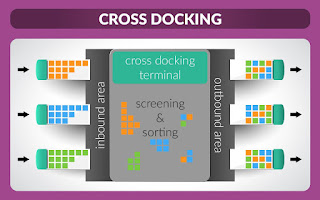
Even if Cross-Docking was used popularly in the trucking industry in 20s and later in military operations, Wal-Mart started using it in 80s and made it popular in retailing. Cross-dock is essentially a process in a warehouse/ facility. In this process, movement of products/ goods from receiving door to shipping door happens without/ minimal handling of materials and with no storage. Among many of the other reasons - saving cost in storage and delivery, faster time to market, reduced space requirement, time effectiveness in fulfilling JIT manufacturing, and improved economies of scale for retailers and transportation, are the main reasons because of which organizations are inclined to extend their supply chain capabilities to adopt this process. However, retail organizations may have to consider many of the other aspects before adopting cross docking. Let us consider few of the important factors which may individually or in combination with other factors influence the decision ...
Demand – Purchase Order – Receipt

Demand – Purchase Order – Receipt is a typical process of information flow from retail stores to the vendors and back from there. Apart from these, most of the full fledged retail lead organizations may include standard practices which may become more complex down the line. But in general, most of the organizations follow the following flow – 1.        Regular Replenishment Orders (for all types of stock items at the retail stores) are created through automated systems which take care of demand planning. Most of the old retailers have the customized complex algorithms to take care of this. While with evolving technologies, packages such as JDA, Oracle and SAP have lot of inbuilt complex algorithms which the lead organizations can customize according to the different parameters required by the retailer. 2.        Most of the times, these replenishment orders are generated on the basis of forecasted demand. Accordingly, the purc...

Advanced Shipment Notice Vs Distribution Shipment Notice

Whenever i used to read about ASN/ DSN (Advanced Shipment Notice/ Distribution Shipment Notice) in my college days, i used to get confused. ASN helps the lead organization to decrease the cost of the movement of goods. It plays a very important role in supply chain management. Advanced Shipment Notice is an advance notification sent by the vendor before the actual physical shipment of goods. This notice is sent via EDI (electronic data interchange), EDIFACT to the lead organization. The vendors send this information to the distribution center of the lead organization this information reaches to the distribution centers/ warehouse way before the physical reception of goods. This notice includes the information related to purchase orders, probable arrival date, items, their quantities, and label related information. This information is used by the distribution center planners to plan the warehouse related activities such as receiving, c...

Transportation - Decision to go out on outsourcing

Image
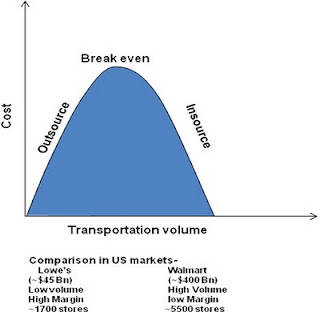
Irrespective of the transportation management (who’s who?), cost of transportation is always paid by the Lead Organization to the carrier. Organization may follow, 1PL and 2PL logistics (Transportation ONLY-insource and outsource). It is said that - Inbound and Outbound load management including transportation is one half or two third of price of the product. So majorly improving SCM, ends up in shortening cost incurred for transportation. Controlling entire inbound freight management may not be effective for all retail organizations. This may vary from organizations inbound volume and value of the load carried each time they receive an inbound freight. Its like a bell curve. I think, for an organization managing in house transportation, cost of the freight is directly proportional to the volume of the freight up to a certain 'breakeven point'. Beyond this point, cost decreases if volume goes on increasing. Hence till this point its better to compensate this cost by negotiat...

Walmart's Inbound Freight Management

WalMart’s recent announcement that it plans to take control of virtually all of its inbound freight has brought the subject of inbound transportation management to the top of the supply chain discussion list. While many retailers, wholesalers and manufacturers have taken control of their inbound freight at some level, even more companies are leaving significant dollars and supply chain opportunity on the floor by letting suppliers make most or all of the transportation decisions. Even companies that have taken some control of inbound freight often have many additional opportunities to improve not only transportation costs but also supply chain visibility, the flow of inventory, supply chain decision-making and other areas by taking inbound freight management to more advanced levels. In this outstanding videocast, we’ll take you through the keys to inbound management success, whether you are just considering the idea, starting to move forward on a program, or would like to take y...